
Revealed Through Open Questionnaires.The Project Is Being Scaled Down — Japanese Macaques at the External Breeding Facilities Contracted Are “Kept for Care, Not Used for Experiments”
JAVA and PEACE, collaborating to end the “Japanese Macaques” project, have repeatedly sent open questionnaires and filed information disclosure requests to the Ministry of Education, Culture, Sports, Science and Technology (MEXT), the Core Center Kyoto University Center for the Evolutionary Origins of Human Behavior (EHUB), and the sub-Core Center National Institute for Physiological Sciences (NIPS), which are running this project, in order to confirm the keeping and supply status of Japanese macaques as well as future plans.
At the same time, as previously reported, we have continuously urged the termination of breeding and the supply of monkeys, and ultimately, the closure of the project itself. However, as also reported (see [Where are the “Japanese Macaques” from? Where are they provided? NBRP “Japanese Macaques” continues to conceal information]), their responses have been consistently “we are not disclosing”.
Since this is a national project funded by taxpayers, it is only natural that the information should be made public. Therefore, in May 2025, JAVA and PEACE once again sent open questionnaires to EHUB and NIPS to confirm the situation.
Although the responses once again reflected a culture of secrecy—for example, by refusing to disclose the “source of the macaques” – this time we were able to confirm several things and newly revealed facts, as follows.
Latest Numbers of Japanese Macaques Kept and Supplied for Experiments
Number of MonkeysKept Continues to Decrease, While the Number Supplied Remains Flat
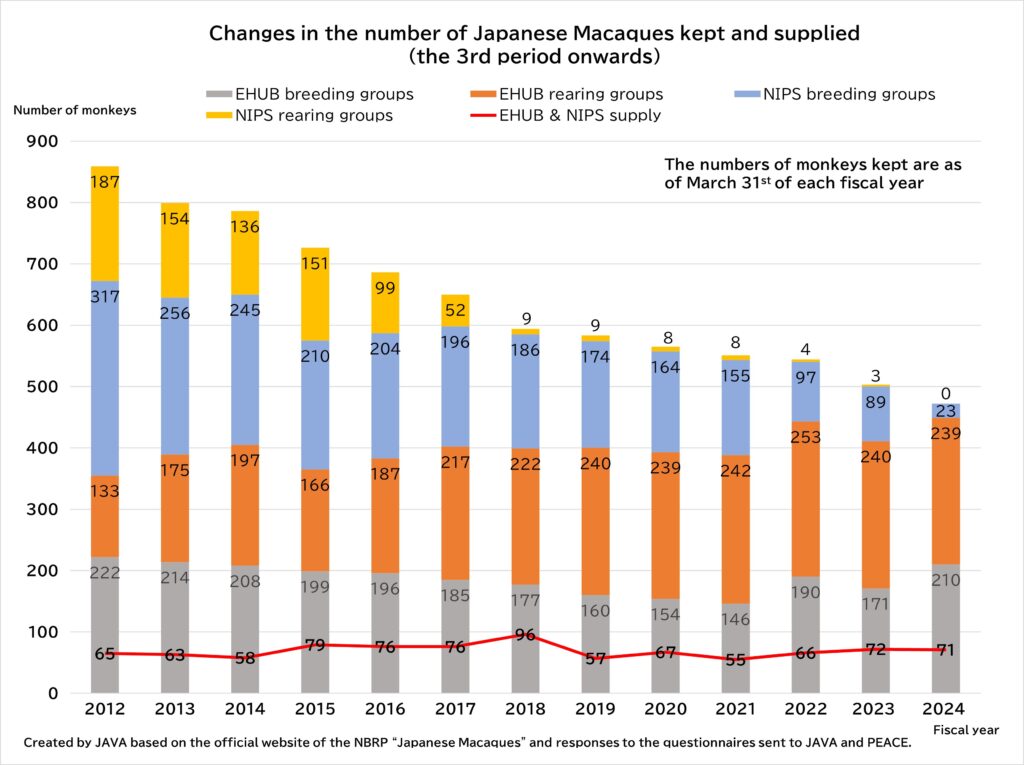
Up to fiscal year 2021, the official website of the NBRP “Japanese Macaques” published the annual numbers of monkeys kept, categorized into breeding groups (mother groups used for reproduction) and rearing groups (offspring bred for experimental provision). Until fiscal year 2022, the numbers of monkeys supplied to research institutions, the numbers of adopted and non-adopted applications were also made public. However, for some reason, these figures have not been published since then, so we sought clarification through questionnaires.
In response, the latest figures as of March 31, 2025, regarding the number of monkeys kept at EHUB and the external breeding facilities contracted by NIPS were confirmed. The reply also stated that they are “currently preparing to update the information on the official website”, which suggests that our repeated pointing out of absence of public updates has had a meaningful effect.
Number of Monkeys Kept as of March 31, 2025
Kyoto University (EHUB): Breeding groups – 210 | Rearing groups – 239
National Institute for Physiological Sciences (NIPS): Breeding groups – 23 | Rearing groups – 0
Total: 472 monkeys, showing a further decrease compared to the previous fiscal year, as illustrated in the graph below.
Number of Monkeys Supplied in FY2024 –71 monkeys
Cumulative Number of Monkeys Supplied Since FY2006 –1,190 monkeys supplied to 40 institutions
No Monkeys Supplied to Overseas Research Institutions
On the NBRP website, many research papers using Japanese macaques supplied through this project are listed as results reports.
Some of the researchers conducting these studies are affiliated with overseas research institutions, and certain papers state that the studies were conducted in accordance with U.S. animal experiments guidelines.
For this reason, we requested confirmation as to whether any Japanese macaques from the NBRP “Japanese Macaque” project had been exported and used in overseas experiments. The response stated: “There have been no cases of monkeys supplied to overseas research institutions”.
If the monkeys were to be exported abroad, the transport time would be far longer than within Japan, resulting in a significantly greater burden on the animals.
Japanese Macaques at the External Breeding Facilities Contracted Are “All Being Kept Without Being Used for Experiments” While the Living Environment Is Unknown
As reported in [We’re collecting signatures! We do request the Minister of Education, Culture, Sports, Science and Technology to abolish the project, breeding and supplying Japanese snow monkeys for animal experiments.]
and [Where are the “Japanese Macaques” from? Where are they provided? NBRP “Japanese Macaques” continues to conceal information], NIPS has entrusted the care of its Japanese macaques to a private company, Amami Wild Animal Research Center, located on Amami-Oshima Island.
According to the data shown in the above graph, as of March 31, 2024, the company was keeping 92 monkeys. Since NIPS had already ended both the breeding and the supply of young monkeys, the question arose as to what would happen to the remaining mother-group animals.
JAVA and PEACE repeatedly asked the operating institutions about the future of these monkeys, but from 2021 to 2024, the response had consistently been “under consideration”, with no progress made.
This time, however, the response stated that “regarding the treatment of monkeys kept at the facility entrusted by NIPS, an announcement will be made through the official website”. Finally, in July 2025, the official NBRP “Japanese Macaques” website of Kyoto University announced that all the monkeys would be kept on the grounds of Kyoto University and NIPS without being used for experiments.
However, the statement did not specify what kind of environment the monkeys would be kept in, and this remains unknown※. Because these animals should be allowed to spend the rest of their lives in conditions close to their natural environment and in consideration of animal welfare, we requested that MEXT instructs EHUB and NIPS to ensure such conditions when submitting the petition.
※During the 17th Open Symposium on NBRP Japanese Macaques, held on August 27, 2025, JAVA directly asked the Representative about this matter and was told that, at present, the monkeys are being kept in individual cages for quarantine purposes.
No Plans to Introduce New Monkeys — Expectation for Further Downsizing of the Project
As for the possibility of introducing new breeding mother groups, the response was the same as last year: “At present, there are no plans under the NBRP Japanese Macaques project to introduce new breeding mother groups”.
Previous responses have revealed that EHUB last introduced Japanese macaques from external sources in FY2009, and NIPS in FY2004. Considering the monkeys’ lifespan of about 30 years, the number of breeding mother groups will naturally continue to decline, and since there are no plans for new introductions, the project is expected to continue shrinking.
No Change in Attitude Regarding the Project’s Future
In the latest questionnaire, we once again asked, “Do you have any plans to bring the NBRP Japanese Macaques project to an end?” However, the answer has remained unchanged since 2021: “We will continue to consider the future of the project while listening to guidance and opinions from relevant authorities”.
To change this stance toward a clear declaration such as “The project will be concluded with the current 5th phase”, we must make our voices opposing the NBRP “Japanese Macaques” project even stronger.
Related article
- We’re collecting signatures!
We do request the Minister of Education, Culture, Sports, Science and Technology to abolish the project, breeding and supplying Japanese snow monkeys for animal experiments. - Submission of Petition to MEXT demanding end to Macaques project
- Where are the “Japanese Macaques” from? Where are they provided? NBRP “Japanese Macaques” continues to conceal information